


.png?width=40&height=40&name=Application%20modernization%20(3).png)


/1.%20Visuals/Website/Navigation/pharma-icon-80-80.jpg?width=40&height=40&name=pharma-icon-80-80.jpg)
/1.%20Visuals/Website/Navigation/food-80-80.png?width=40&height=40&name=food-80-80.png)
/1.%20Visuals/Website/Icons/print%20packaging.png?width=40&height=40&name=print%20packaging.png)


/1.%20Visuals/Website/Icons/CTG%20Academy.png?height=56&name=CTG%20Academy.png)


 Global
 Austria
 Belgium
 Denmark
 Germany
 Italy
Italy Romania
 Sweden
 Switzerland
 The Netherlands
 United Kingdom
 United States
Bringing a new drug to market is one of the most demanding challenges in the pharmaceutical industry. Clinical trials are essential, but they are long, costly, and complex. On average, trials take 8 to 12 years. Every delay adds risk and expense, and every inefficiency slows the pace of innovation. AI agents are changing that.
The Challenge
Clinical trials involve countless moving parts: patient recruitment, data collection, compliance checks, and reporting. These processes often rely on fragmented systems and manual workflows. The result? Bottlenecks, delays, and rising costs.
Recruiting the right patients can take months. Gathering data from multiple sources is time-consuming. Ensuring compliance with strict regulatory standards adds another layer of complexity. For pharma companies under pressure to deliver faster, this traditional approach is no longer sustainable.
The Solution: Multi-Agent Systems
AI offers a new way forward. Not through one massive system overhaul, but through modular, intelligent agents that handle specific tasks and work together seamlessly. This approach is called multi-agent orchestration, and it is already transforming how clinical trials are managed.
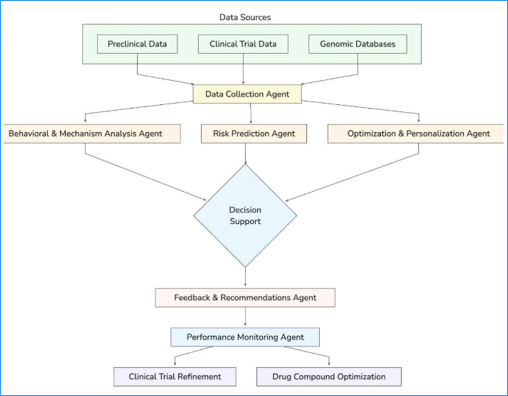
Instead of building one monolithic solution, pharma companies can deploy multiple AI agents, each designed for a specific role:
- Patient Selection Agents: Match candidates using medical records.
- Data Collection Agents: Aggregate trial data from multiple sources.
- Compliance Agents: Monitor regulatory requirements in real time.
- Orchestration Agents: Coordinate tasks across the trial lifecycle.
This modular approach means companies can start small, validate results, and scale gradually, without disrupting existing systems.
Imagine this scenario:
A patient selection agent identifies eligible participants based on medical records. A compliance agent checks regulatory adherence before enrollment. An orchestration agent triggers the next steps automatically, ensuring that data flows seamlessly between systems.
Instead of weeks of manual coordination, these tasks happen in hours. Researchers stay focused on science, while AI handles the complexity behind the scenes.
Start small
Building a full multi-agent system doesn’t happen overnight. The smartest approach is to begin with one targeted use case, such as patient selection or compliance monitoring. Test it. Learn from it. Then expand to other areas like data aggregation and orchestration. This incremental strategy reduces risk, builds confidence, and creates a foundation for long-term transformation.
Ready to explore what your first AI agent could look like? Let’s talk about the small steps that lead to big change.
Want more Inspiration? Explore other AI use case in Pharma:
 - Smarter Manufacturing and Quality Control with AI
-  Post-Market Surveillance and Safety Powered by AI
-  Accelerating Pharma Research with AI Agents
Source: Leveraging Agentic AI to Accelerate Drug Discovery and Development, Transforming Patient Recruitment with AI Agents in Clinical Trials, Why AI Agents Are the Superheroes of Modern Clinical Trials
/1.%20Visuals/Website/Icons/x-twitter.svg)


