


/1.%20Visuals/Website/Icons/RegulatoryCompliance_Visuals_Navigation%20(1).png?width=40&height=40&name=RegulatoryCompliance_Visuals_Navigation%20(1).png)


/1.%20Visuals/Website/Icons/Testing_Visuals_IconNavigation%20(1).png?width=40&height=40&name=Testing_Visuals_IconNavigation%20(1).png)


/1.%20Visuals/Website/Icons/government%201.png?width=40&height=40&name=government%201.png)
/1.%20Visuals/Website/Icons/energy_utilities%201.png?width=40&height=40&name=energy_utilities%201.png)
/1.%20Visuals/Website/Icons/defense%201.png?width=40&height=40&name=defense%201.png)
/1.%20Visuals/Website/Icons/food%201.png?width=40&height=40&name=food%201.png)
/1.%20Visuals/Website/Icons/finance%201.png?width=40&height=40&name=finance%201.png)
/1.%20Visuals/Website/Icons/manufacturing%201.png?width=40&height=40&name=manufacturing%201.png)


/1.%20Visuals/Website/Icons/CTG%20Academy.png?height=56&name=CTG%20Academy.png)


 Global
 Austria
 Belgium
 Denmark
 Germany
 Italy
Italy Romania
 Sweden
 Switzerland
 The Netherlands
 United Kingdom
 United States
Microsoft’s 2026 Release Wave 1 continues to modernize Dynamics 365 Finance with a strong focus on performance, flexibility, and compliance. This release builds on the foundations that were introduced in previous waves and introduces capabilities that help finance teams process transactions faster, reduce manual effort, and respond more effectively to regulatory and operational complexity. In this article, we describe the Finance updates we’re most excited about and why they matter for organizations.
New financial journals
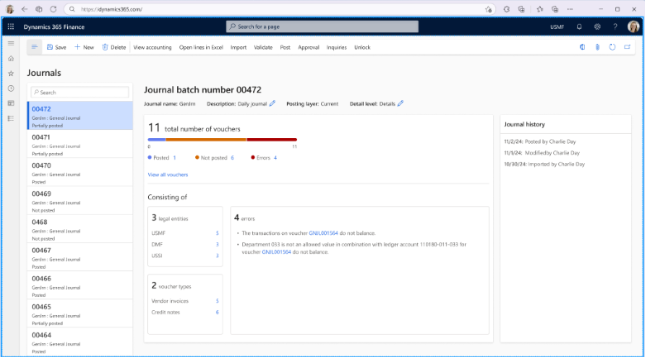
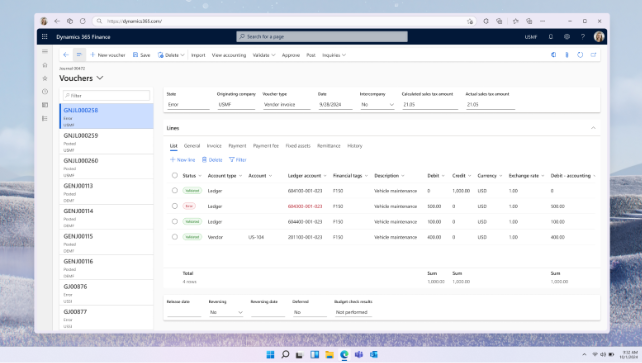
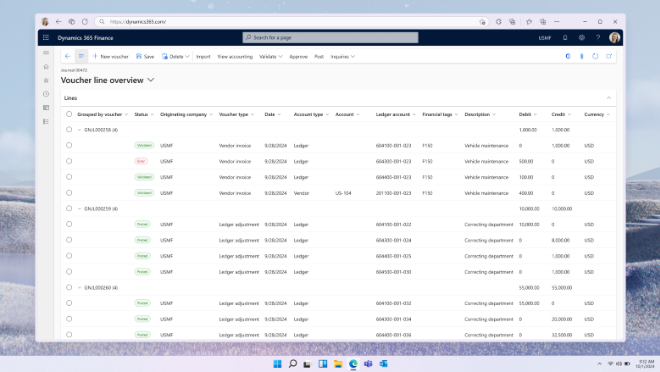
The new financial journal framework becomes the foundation for all financial journals in Dynamics 365 Finance. It significantly improves performance across the entire journal lifecycle, from import and validation to posting. Finance teams can now work with vouchers for multiple legal entities within a single journal, which is especially valuable for shared service centers and multinational organizations. The introduction of document types provides clearer lifecycle control and improved analytical insight into different transaction categories, while still allowing transactions to be prepared externally and imported through data management. Importantly, this framework is designed to evolve further, gradually reaching functional parity with classic journals while enabling more scalable and future-proof financial processes.
Learn more at: learn.microsoft.com
Unified e-invoicing integration framework
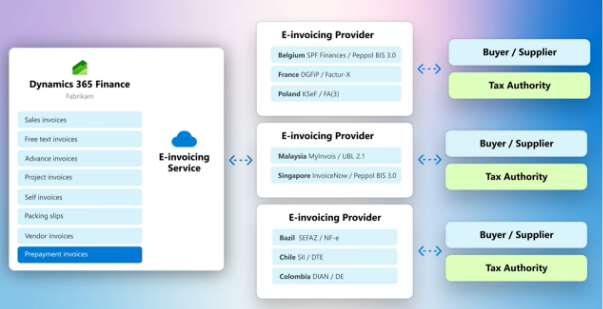
A unified e-invoicing integration framework further increases flexibility by decoupling Dynamics 365 Finance from any single e-invoicing provider. Organizations can integrate with multiple external platforms using a unified data contract and API pipeline for both incoming and outgoing invoices. This approach avoids vendor lock-in, supports country-specific provider choices, and makes it easier to scale e-invoicing coverage as regulatory requirements expand globally.
Learn more at: learn.microsoft.com
Preview automatic bank reconciliation matching results
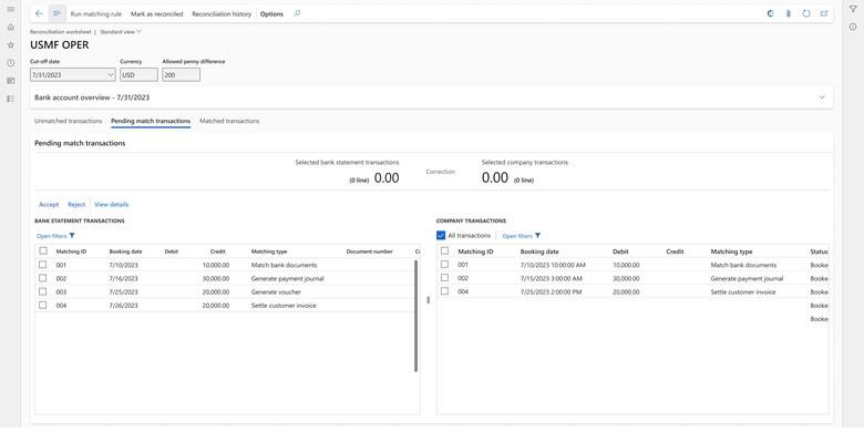
Finance teams will also benefit from previewing automatic bank reconciliation matching results before postings are finalized. This feature allows users to review, approve, or reject matching outcomes generated by reconciliation rules, ensuring higher accuracy and reducing the risk of incorrect postings. By introducing a structured review step with a dedicated pending-review screen, organizations gain better control over cash reconciliation while still benefiting from automation.
Learn more at: learn.microsoft.com
Enhancements to Invoice capture
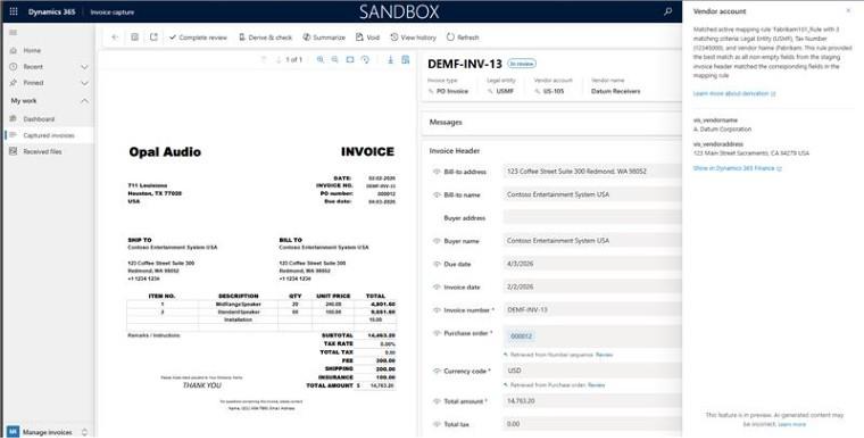
Enhancements to invoice capture push touchless processing even further. AI-based derivation at invoice header level improves matching with purchase orders and procurement categories, while continuous learning ensures that user corrections improve future recognition. The new side-by-side view of invoice, purchase order, and invoice lines reduces context switching and speeds up exception handling. In addition, improved charge recognition and allocation automatically identifies and distributes header- and line-level charges, preventing mismatches and reducing downstream corrections. Together, these improvements significantly lower manual effort and increase straight-through processing rates.
Learn more at: learn.microsoft.com
Improvements in BPA
Business Performance Analytics (BPA) benefits from expanded data models and more frequent data refreshes. The addition of the Acquire-to-Dispose business flow improves asset lifecycle visibility, while hourly refreshes significantly reduce latency between transactional data and analytics. This allows finance leaders to monitor performance with greater accuracy and act on insights faster.
Learn more at: learn.microsoft.com and learn.microsoft.com
Accelerate planning with quick-start templates
To help organizations adopt planning capabilities more quickly, Microsoft introduces quick-start templates for business performance planning. These templates guide users through initial configuration by planning area, starting with OPEX and expanding to Revenue, Workforce, and CAPEX. This lowers the barrier to entry for advanced planning and budgeting, enabling finance teams to move beyond static budgets toward more dynamic and insight-driven financial planning.
Learn more at: learn.microsoft.com
Meet requirements for e-invoicing and e-reporting in France
Finally, compliance remains a key theme with new support for e-invoicing and e-reporting requirements in France. This feature enables compliant B2B invoice exchange and lifecycle status reporting through the certified provider EDICOM, aligned with French legislation. With public availability planned for April 2026 and general availability in August 2026, this update helps organizations prepare proactively for mandatory electronic invoicing while ensuring accurate transmission to tax authorities.
Learn more at: learn.microsoft.com
Looking Ahead
With the 2026 Spring Release, Dynamics 365 Finance continues its shift toward high-performance processing, regulatory agility, and intelligent automation. These updates help organizations scale financial operations, reduce manual effort, and stay compliant in an increasingly complex regulatory landscape.
/1.%20Visuals/Website/Icons/x-twitter.svg)


