


/1.%20Visuals/Website/Icons/RegulatoryCompliance_Visuals_Navigation%20(1).png?width=40&height=40&name=RegulatoryCompliance_Visuals_Navigation%20(1).png)


/1.%20Visuals/Website/Icons/Testing_Visuals_IconNavigation%20(1).png?width=40&height=40&name=Testing_Visuals_IconNavigation%20(1).png)


/1.%20Visuals/Website/Icons/government%201.png?width=40&height=40&name=government%201.png)
/1.%20Visuals/Website/Icons/energy_utilities%201.png?width=40&height=40&name=energy_utilities%201.png)
/1.%20Visuals/Website/Icons/defense%201.png?width=40&height=40&name=defense%201.png)
/1.%20Visuals/Website/Icons/food%201.png?width=40&height=40&name=food%201.png)
/1.%20Visuals/Website/Icons/finance%201.png?width=40&height=40&name=finance%201.png)
/1.%20Visuals/Website/Icons/manufacturing%201.png?width=40&height=40&name=manufacturing%201.png)


/1.%20Visuals/Website/Icons/CTG%20Academy.png?height=56&name=CTG%20Academy.png)


 Global
 Austria
 Belgium
 Denmark
 Germany
 Italy
Italy Romania
 Sweden
 Switzerland
 The Netherlands
 United Kingdom
 United States
As organizations rely more heavily on low‑code platforms to digitize processes and innovate faster, expectations around user experience, scalability, and governance continue to rise. With the 2026 Release Wave 1, Microsoft Power Platform takes another step toward meeting those expectations by combining richer AI‑assisted development with a more consistent user experience and stronger lifecycle management. The result is a platform that empowers both citizen developers and professional developers, while giving IT teams the confidence that solutions can evolve safely at scale.
Power Apps
A modern and consistent experience
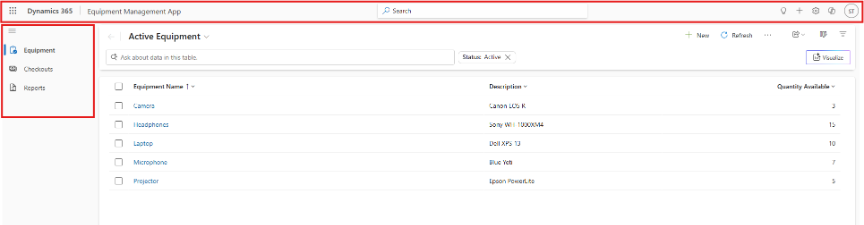
Model‑driven apps in Power Apps now fully adopt the modern, refreshed experience as the standard interface. This ensures that all model‑driven apps run on a single, consistent user experience, with a streamlined header, navigation, and updated controls that improve usability and accessibility. By retiring the classic look, Microsoft removes the last legacy option and establishes one clear baseline for all model‑driven apps. For organizations, this means a predictable and uniform user experience, simplified training and support, and a stable foundation that can evolve in step with future platform enhancements.
Mobile resilience and AI‑assisted productivity
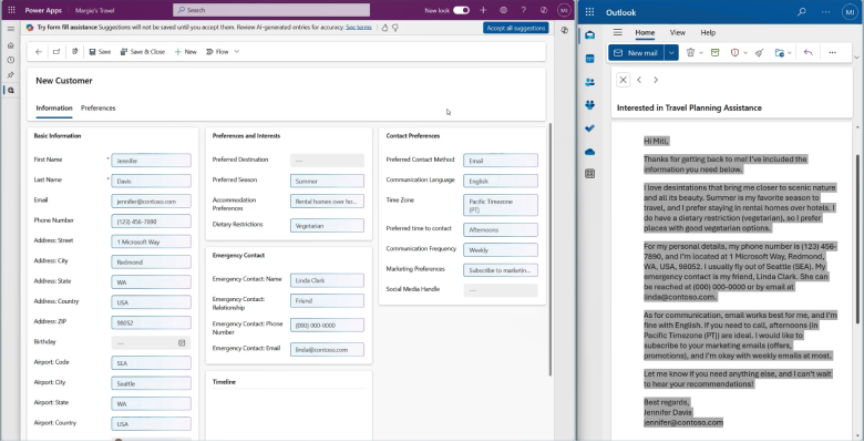
Canvas apps continue to expand their mobile and offline capabilities, allowing makers to design applications that remain productive even in environments with limited connectivity. Improved online and offline configurations using Dataverse data, combined with push notifications in custom‑branded apps, make Power Apps suitable for a broader range of frontline and mobile scenarios. In parallel, new AI enhancements help users understand and act on data faster through improved row summaries and form‑filling assistance, including smart paste capabilities that reduce repetitive data entry. Together, these updates save time for both app users and makers, while extending the reach of Power Apps into more demanding operational contexts.
Accelerating development with generative pages and code‑first workflows
Power Apps now supports building generative pages using external AI code generation tools such as GitHub Copilot or Claude Code. This introduces a true code‑first workflow for developers who prefer working outside of Power Apps Studio, while remaining fully integrated with the platform. By allowing generative page creation, editing, and deployment from familiar development tools, organizations can significantly speed up solution delivery, reduce manual configuration, and better align low‑code and pro‑code development practices.
Power Pages
AI‑driven site creation with built‑in security
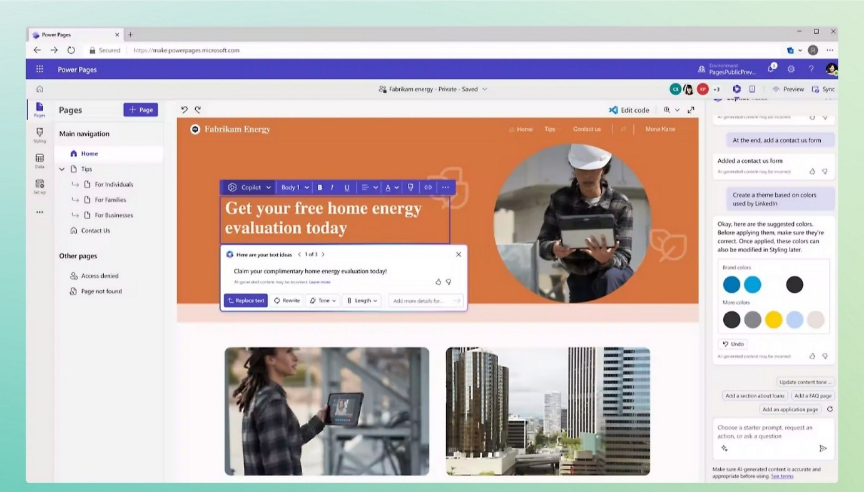
Power Pages continues to mature as an enterprise‑grade platform for external-facing websites. With agentic AI coding tools, makers can now generate and deploy complete Power Pages sites more efficiently, while relying on Power Pages for hosting, scalability, and governance. New auditing capabilities capture end‑user actions on Dataverse records, supporting compliance and traceability requirements. In addition, the security agent for site creators helps configure complex roles and permissions during authoring, reducing the risk of misconfiguration and improving security by design rather than as an afterthought.
Power Automate
Smarter automation with built‑in safety nets
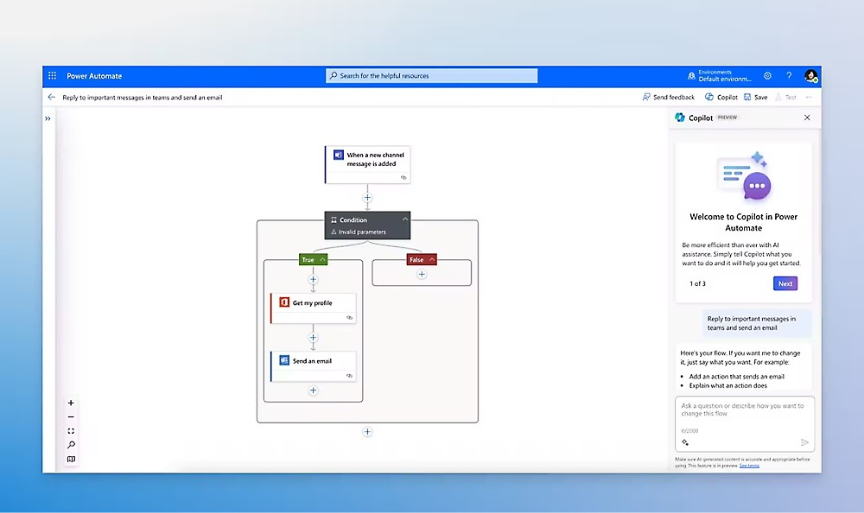
Power Automate deepens its AI‑assisted experience with Copilot embedded directly in the flow designer. Users can now describe, build, refine, and troubleshoot flows through conversational interaction, lowering the barrier to automation and accelerating iteration. At the same time, Microsoft introduces the ability to restore accidentally deleted flows, addressing a common pain point in automation lifecycle management. This combination of smarter creation and better recovery mechanisms makes automation more accessible while reducing operational risk.
Microsoft Copilot Studio
From experimentation to scalable agent adoption
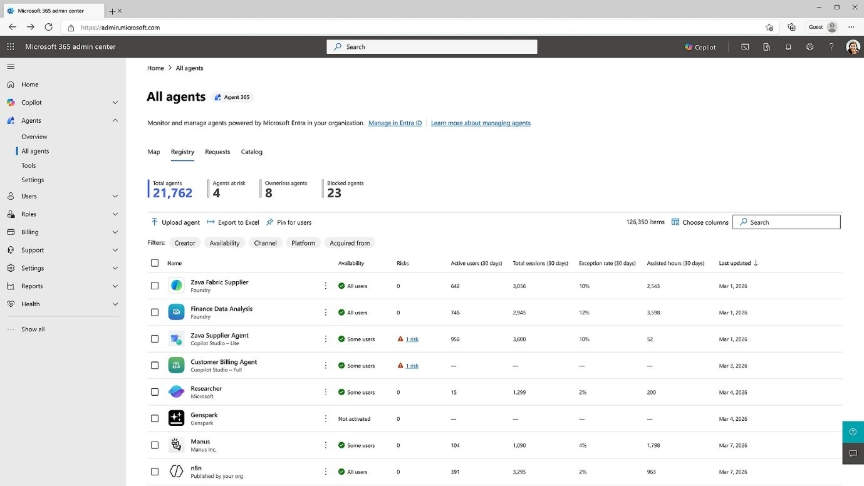
Microsoft Copilot Studio continues to evolve toward large‑scale, practical adoption of AI agents. New capabilities allow agents to automate repetitive tasks across both web and desktop applications through computer use, reducing manual effort and error‑prone work. At the same time, Copilot Studio now leverages Microsoft 365 Copilot memory to suggest relevant, ready‑to‑customize agents based on users’ actual work. This helps makers get started faster, increases adoption, and shortens time to value by aligning agent creation with real business needs.
Application Lifecycle Management
Strengthening ALM across the platform
To support growing Power Platform estates, Microsoft introduces native GitHub integration for source control within the Power Platform solution experience. This brings version control, change tracking, and team collaboration into the platform itself, benefiting citizen developers, professional developers, and administrators alike.
Preparing for What’s Next: Power Platform Deprecations in Context
As part of the 2026 Release Wave 1, Microsoft also announces several important deprecations across the Power Platform, reinforcing its move toward a more consistent, modern, and AI‑ready experience. These changes include the deprecation of legacy components such as the Editable Grid and Read‑Only Grid controls, as well as the retirement of the classic look for model‑driven apps, which will no longer be available starting April 2026.
The key message behind these deprecations is not disruption, but standardization. By consolidating around the modern interface, Microsoft ensures that all model‑driven apps benefit from ongoing usability improvements, accessibility enhancements, and AI‑powered capabilities that are only available in the modern experience. Importantly, these deprecations do not impact application logic, data, or security configuration. Existing apps will continue to work as expected, automatically adopting the modern look without requiring functional rework.
Looking Ahead
The 2026 Release Wave 1 shows how Microsoft Power Platform is maturing into a unified environment where innovation, AI, and governance reinforce each other. By modernizing user experiences, enabling faster development with AI and code‑first tooling, and strengthening lifecycle management, the platform empowers organizations to build intelligent solutions with confidence. All without losing control as adoption scales.
/1.%20Visuals/Website/Icons/x-twitter.svg)


