


/1.%20Visuals/Website/Icons/RegulatoryCompliance_Visuals_Navigation%20(1).png?width=40&height=40&name=RegulatoryCompliance_Visuals_Navigation%20(1).png)


/1.%20Visuals/Website/Icons/Testing_Visuals_IconNavigation%20(1).png?width=40&height=40&name=Testing_Visuals_IconNavigation%20(1).png)


/1.%20Visuals/Website/Icons/government%201.png?width=40&height=40&name=government%201.png)
/1.%20Visuals/Website/Icons/energy_utilities%201.png?width=40&height=40&name=energy_utilities%201.png)
/1.%20Visuals/Website/Icons/defense%201.png?width=40&height=40&name=defense%201.png)
/1.%20Visuals/Website/Icons/food%201.png?width=40&height=40&name=food%201.png)
/1.%20Visuals/Website/Icons/finance%201.png?width=40&height=40&name=finance%201.png)
/1.%20Visuals/Website/Icons/manufacturing%201.png?width=40&height=40&name=manufacturing%201.png)


/1.%20Visuals/Website/Icons/CTG%20Academy.png?height=56&name=CTG%20Academy.png)


 Global
 Austria
 Belgium
 Denmark
 Germany
 Italy
Italy Romania
 Sweden
 Switzerland
 The Netherlands
 United Kingdom
 United States
Where companies have spent years focusing on preventing cyberattacks, today cyber resilience is taking center stage: not only protecting systems, but continuing operations and recovering quickly when things go wrong. IT services provider and cybersecurity specialist Cegeka reinforces this shift with a targeted cyber recovery approach. Cegeka launches this approach during Cybersec Europe 2026.
According to the ENISA Threat Landscape Report 2025, ransomware accounts for more than 80% of cyber incidents and is the main cause of operational disruption for organizations across Europe. At the same time, the impact remains significant: according to the IBM Cost of a Data Breach Report 2025, a data breach costs organizations worldwide an average of over $4 million.
“Cybersecurity has evolved into a strategic priority for companies,” says Fabrice Wynants, Global VP Cybersecurity & Networking at Cegeka. “Protection remains a top priority, of course, but protection alone is no longer sufficient. Organizations need to assume that incidents will occur. The real question is how resilient you are and how quickly you can become operational again.”
From cybersecurity to cyber resilience
Cegeka has long advocated a shift from traditional cybersecurity to end-to-end cyber resilience. The focus is not on a single aspect, but on the full picture: from prevention and detection to response and recovery.
“Cyber resilience means being able to continue operating as an organization, even when systems are under pressure or temporarily unavailable,” says Gaetan Willems, Global VP Cloud & Digital Platforms at Cegeka. “Recovery is not a separate phase afterwards, but an essential part of the entire process. You need to know how to restart your business even before anything happens.”
This shift also reflects the reality within organizations today. Cybersecurity ranks high on executive agendas. According to the Gartner 2025 CEO Survey, 85% of CEOs consider it critical for growth, while there is growing awareness that protection alone is not enough.
Cyber recovery: from IT recovery to business continuity
In practice, the biggest impact of an incident occurs when systems actually go down and business processes come to a halt. Yet recovery is still often underestimated or only addressed when it is already too late.
Cegeka’s cyber recovery approach goes beyond traditional backup or disaster recovery. It focuses on restarting an organization in a controlled and secure way after an incident, with a focus on the most critical business processes.
“We often see organizations trying to recover everything at once, which leads to delays and complexity,” says Willems. “That is why we start from the principle of the ‘Minimum Viable Company’: what is the minimum you need to get your business up and running again?”
By identifying critical processes, systems, and data in advance, organizations can significantly reduce downtime and limit the overall impact of an incident.
This approach also extends beyond cyberattacks. Other disruptions, such as system outages or infrastructure incidents, also make clear how dependent companies are on their digital processes. At the same time, regulations such as NIS2 and DORA reinforce this focus by explicitly emphasizing business continuity and recovery capabilities.
End-to-end approach
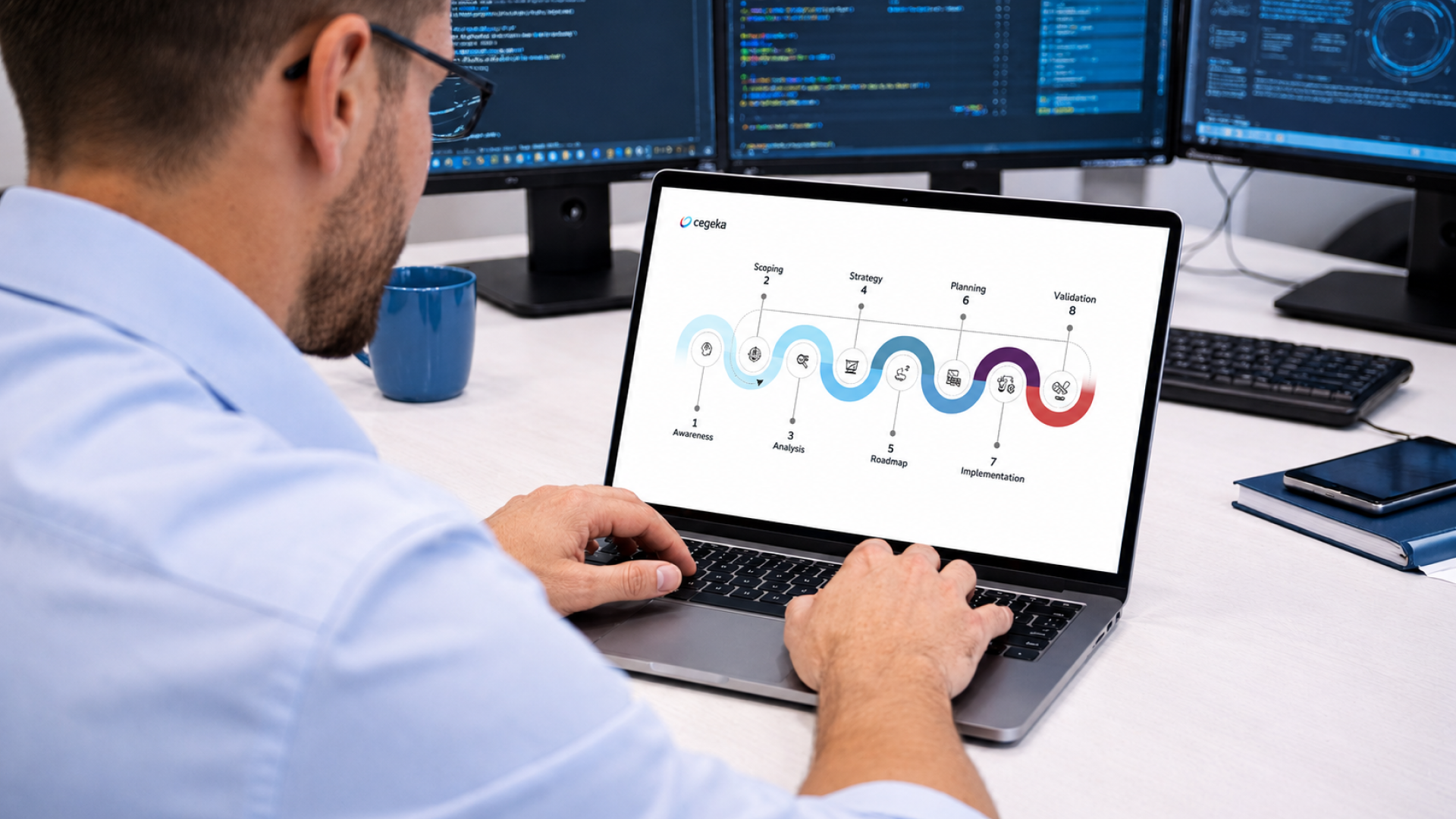
According to Cegeka, the key lies in combining all aspects of cybersecurity and IT into one integrated approach.
“What organizations need today is a partner that understands and manages the full scope,” concludes Wynants. “Cyber resilience is a continuous process: from awareness and prevention to detection, response and recovery. At the same time, it requires an end-to-end IT approach, where cybersecurity is fully embedded rather than treated as an add-on. That integrated approach enables organizations to reduce risk and recover quickly when it matters most.”
/1.%20Visuals/Website/Icons/x-twitter.svg)


