


/1.%20Visuals/Website/Icons/RegulatoryCompliance_Visuals_Navigation%20(1).png?width=40&height=40&name=RegulatoryCompliance_Visuals_Navigation%20(1).png)


/1.%20Visuals/Website/Icons/Testing_Visuals_IconNavigation%20(1).png?width=40&height=40&name=Testing_Visuals_IconNavigation%20(1).png)


/1.%20Visuals/Website/Icons/government%201.png?width=40&height=40&name=government%201.png)
/1.%20Visuals/Website/Icons/energy_utilities%201.png?width=40&height=40&name=energy_utilities%201.png)
/1.%20Visuals/Website/Icons/defense%201.png?width=40&height=40&name=defense%201.png)
/1.%20Visuals/Website/Icons/food%201.png?width=40&height=40&name=food%201.png)
/1.%20Visuals/Website/Icons/finance%201.png?width=40&height=40&name=finance%201.png)
/1.%20Visuals/Website/Icons/manufacturing%201.png?width=40&height=40&name=manufacturing%201.png)


/1.%20Visuals/Website/Icons/CTG%20Academy.png?height=56&name=CTG%20Academy.png)


 Austria
 Belgium
 Denmark
 Germany
 Italy
Italy Romania
 Sweden
 Switzerland
 The Netherlands
 United Kingdom
 United States
RotterMaatje is a great example of responsible technology in practice. Developed by colleagues from Cegeka Netherlands in collaboration with Pauluskerk Rotterdam and Rotterdam University of Applied Sciences, the initiative demonstrates how artificial intelligence (AI) can be used to address social challenges and expand access for vulnerable communities.
In a world where digital transformation can widen inequalities, RotterMaatje takes a different approach. Rather than optimizing processes alone, it puts people first. The chatbot helps individuals experiencing homelessness, volunteers navigating complex support systems, and residents seeking reliable information about healthcare, shelter, legal assistance, and social services.
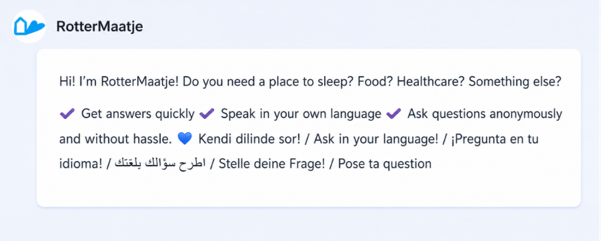
By making information more accessible and inclusive, RotterMaatje illustrates how technology can become an enabler of equal opportunities and human dignity.
Technology meeting people where they are
At the heart of RotterMaatje lies a simple yet important principle: access to support is a human right and should be available to everyone, regardless of their background, language proficiency, or digital literacy.
That’s why this chatbot was designed with accessibility and inclusion as core requirements, offering:
- Information at B1 reading level
- Multilingual support (Dutch, English, Polish, Arabic, and more)
- Clear guidance on shelters, services, and regulations.
For people with a migrant background, limited literacy skills, mild intellectual disabilities, or many other vulnerabilities, these features are essential tools for participation and self-reliance.
Innovation rooted in human centricity
The project demonstrates how collaboration between academia, civil society, and the tech industry can accelerate innovation while creating tangible social value.
The first real-world test took place at the Pauluskerk in Rotterdam. Visitors scanned a QR code and immediately started using the chatbot. What happened next was very insightful: one person tried it, then another, then a small crowd. People explained the tool to each other and helped one another navigate it.
Students from Rotterdam University of Applied Sciences took the prototype further, developing a working platform in three multidisciplinary teams. Their contributions resulted in a robust first version, which features:
- A triage agent that classifies questions by topic, language, and urgency, even flagging potential emergencies
- A RAG system connected to a curated knowledge base of shelters, municipal rules, and practical help
- Two user modes: one for volunteers, one for people seeking help
- Structured intake support for assessing needs
- A first custom-trained language model tailored to the social-care domain.
This is human-centric design in action: RotterMaatje works because it solves a real problem in a way that feels intuitive, safe, and easily accessible.
Responsible AI by design
From day one, privacy, information security, transparency, and user protection were treated as foundational requirements for RotterMaatje.
The chatbot actively warns users when they attempt to share sensitive personal information, such as citizen service numbers, passwords, or contact details. The objective is clear: protect users and build trust.
Even more, one aspect became clear during the testing stages: AI is only as good as the information behind it. Outdated data can lead to wrong referrals, and this is something we cannot afford. In a digital landscape where many of us are exposed to inaccurate information on a daily basis, maintaining the knowledge base isn’t a technical chore, but an ethical obligation that safeguards accuracy and responsible use.
Strengthening human connection rather than replacing it
The most important lesson from RotterMaatje is that AI should enhance human support, not replace it. The chatbot removes friction by making information easier to access, reducing administrative barriers, and helping people find the right support faster. In doing so, it enables volunteers and social workers to spend more time on what AI cannot replicate: empathy, trust, and meaningful human interaction.
RotterMaatje serves as a blueprint for how AI can serve society when built with empathy, responsibility, and collaboration. It shows that technology can be a force for good, empowering communities and helping to ensure that no one is left behind. For Cegeka, this is what ESG-driven innovation looks like.
If you’d like to learn more or see how you can contribute to this project, please reach out to Constantijn Rijsdijk (constantijn.rijsdijk@cegeka.com).
/1.%20Visuals/Website/Icons/x-twitter.svg)


