


/1.%20Visuals/Website/Icons/RegulatoryCompliance_Visuals_Navigation%20(1).png?width=40&height=40&name=RegulatoryCompliance_Visuals_Navigation%20(1).png)


/1.%20Visuals/Website/Icons/Testing_Visuals_IconNavigation%20(1).png?width=40&height=40&name=Testing_Visuals_IconNavigation%20(1).png)


/1.%20Visuals/Website/Icons/government%201.png?width=40&height=40&name=government%201.png)
/1.%20Visuals/Website/Icons/energy_utilities%201.png?width=40&height=40&name=energy_utilities%201.png)
/1.%20Visuals/Website/Icons/defense%201.png?width=40&height=40&name=defense%201.png)
/1.%20Visuals/Website/Icons/food%201.png?width=40&height=40&name=food%201.png)
/1.%20Visuals/Website/Icons/finance%201.png?width=40&height=40&name=finance%201.png)
/1.%20Visuals/Website/Icons/manufacturing%201.png?width=40&height=40&name=manufacturing%201.png)


/1.%20Visuals/Website/Icons/CTG%20Academy.png?height=56&name=CTG%20Academy.png)


 Austria
 Belgium
 Denmark
 Germany
 Italy
Italy Romania
 Sweden
 Switzerland
 The Netherlands
 United Kingdom
 United States
The pattern itself is familiar.
Organizations have seen it before with SharePoint, Microsoft Teams, and the Power Platform. Each wave expanded access, accelerated innovation, and eventually introduced the same downside: too much growth without enough visibility, ownership, or control. The result was complexity, duplication, and governance gaps that had to be addressed later.
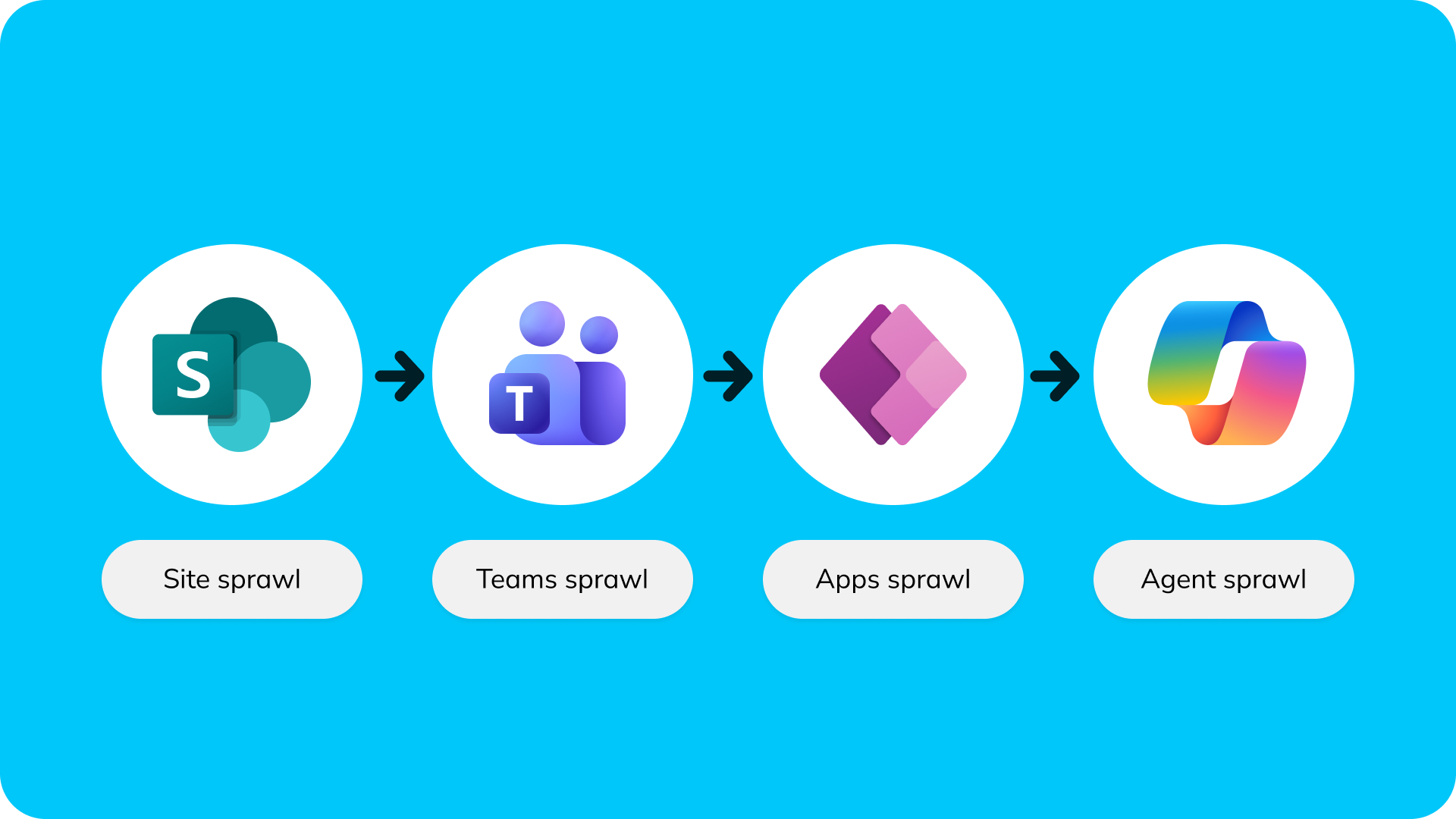
Figure 1: Sprawl history across digital workplace applications
Now the same pattern is emerging with AI agents, only faster and with far greater business impact.
According to Gartner, "By 2028, a typical enterprise could have over 150,000 AI agents in use."
Yet only 13% of organizations believe they have the right governance in place.
That is what leads to agent sprawl: the rapid and uncontrolled proliferation of AI agents across the organization.
The challenge is not agent creation itself, but how to govern agents once they begin to scale. Organizations that act early can avoid repeating the mistakes of earlier technology waves and put the right model in place before sprawl becomes costly to reverse.

What is agent sprawl, and why it matters
Agent sprawl begins when AI agents are created faster than the organization can govern them. What starts as useful local experimentation quickly turns into a fragmented landscape of agents with unclear ownership, inconsistent controls, and limited visibility.
It often starts with legitimate use cases across different functions:
-
A marketing team builds an agent for content generation
-
Sales deploys one for lead qualification
-
HR experiments with automation for recruitment
Each of these agents may create value on its own. The problem begins when they scale without coordination. Different teams solve similar problems in different ways, ownership becomes unclear, and no one has a complete view of which agents exist, what data they access, or whether they still deliver value.
The consequences are tangible:
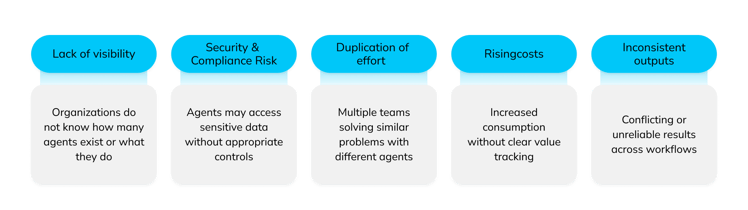
As the number of agents grows, organizations face duplication, inconsistent quality, unmanaged access to internal data, rising costs, and no clear process to monitor or retire what is no longer needed. That is when agent sprawl stops being a local experimentation issue and becomes a governance, risk, and operating model problem.
You don’t stop agents, you structure them
A common response to these risks is to tighten control by restricting or centralizing agent creation. On paper, that sounds reasonable. In practice, it rarely holds.
When employees see clear value, they will continue to experiment, especially when the tools are widely accessible. If organizations respond only with restriction, agent usage does not disappear. It simply moves out of sight, creating more shadow usage, less consistency, and greater governance risk.
The better approach is not to stop agents, but to structure how they are created, governed, and scaled:
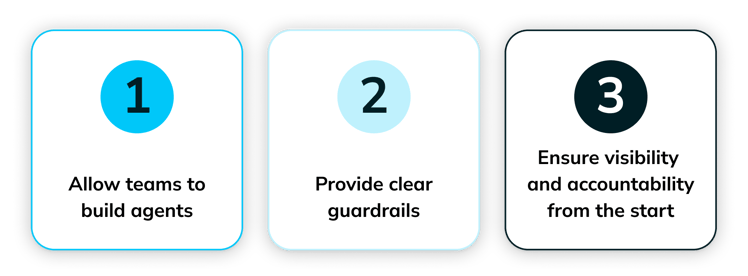
The organizations that succeed will not be the ones that suppress experimentation. They will be the ones that turn it into a governed model for repeatable scale.
A practical framework to manage agent sprawl
To bring control without slowing innovation, organizations need more than isolated measures. They need a practical operating model built on five connected pillars.
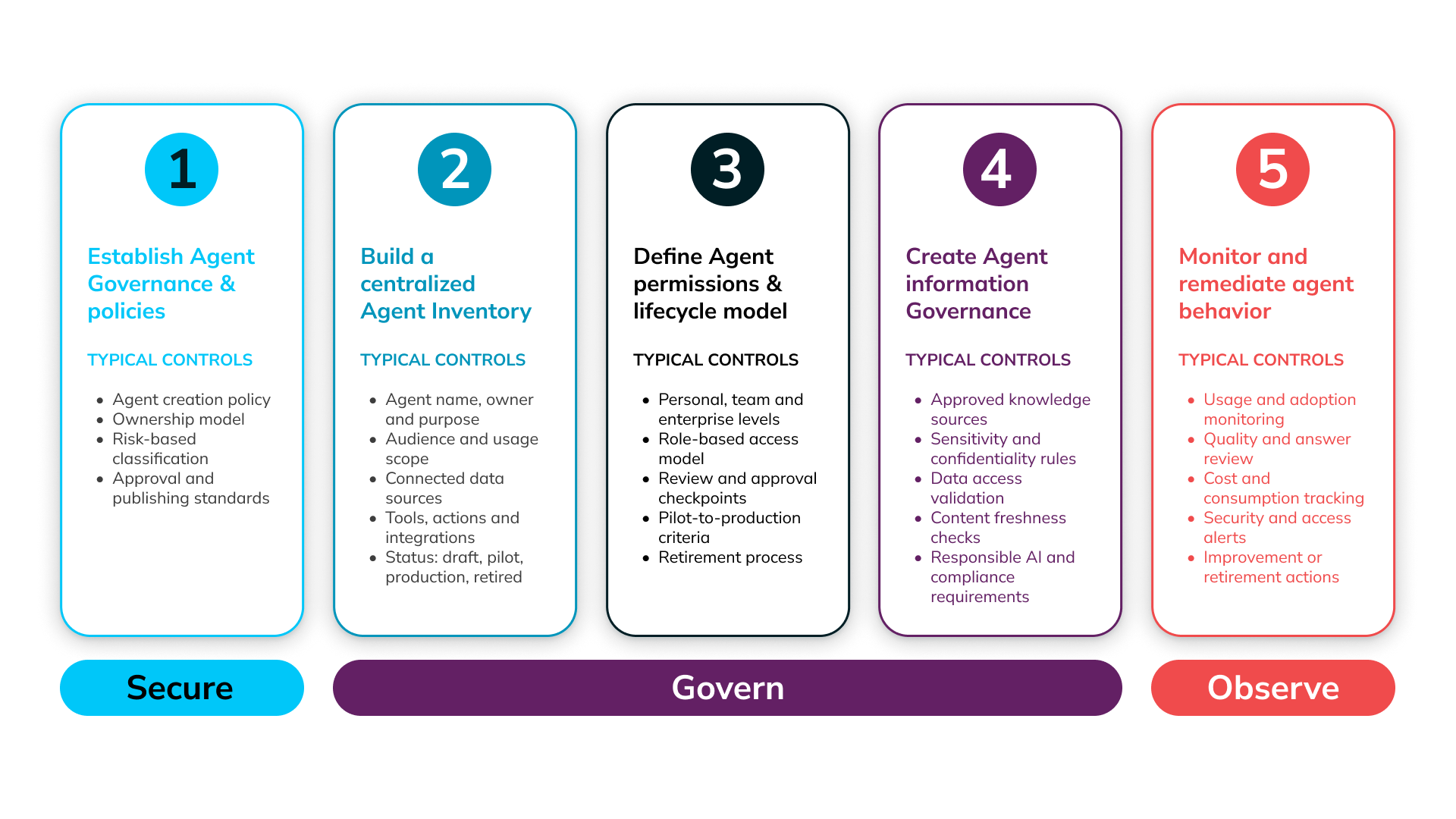
1. Establish governance and policies
As more teams start building and using agents, decisions quickly become fragmented. Clear governance helps organizations set the right boundaries early, so innovation can scale without creating unnecessary risk or duplication.
In order to prevent agent sprawl organizations need to define:
- Who can create agents
- What approval processes are required
- Which use cases are allowed or restricted
- How risks are classified (e.g., low-impact vs high-risk agents)
Without these guardrails, every new agent adds risk and inconsistency. Governance creates the boundaries that allow innovation to scale with confidence.
2. Build a centralized agent inventory
An agent inventory is a centralized overview of all agents in use across the organization, including who owns them, what they do, and what they connect to. It gives organizations the visibility they need to detect duplication, understand risk, and manage agents more consistently at scale.
A centralized inventory provides visibility into:
- All agents across the organization (including shadow usage)
- Their purpose and business value
- Ownership and accountability
- Connected data sources and integrations
- Lifecycle status (e.g., pilot, production, retired)
A centralized inventory turns agents from isolated experiments into manageable enterprise assets.
Once organizations know which agents exist and who owns them, they can begin applying differentiated controls across the lifecycle.
3. Define permissions and lifecycle management
As agents scale across the organization, control becomes essential. Clear permissions and structured lifecycle management ensure agents only access what they should, changes are managed correctly, and obsolete agents don’t remain active unnoticed.
These principles can be translated into a simple governance model, as illustrated below.
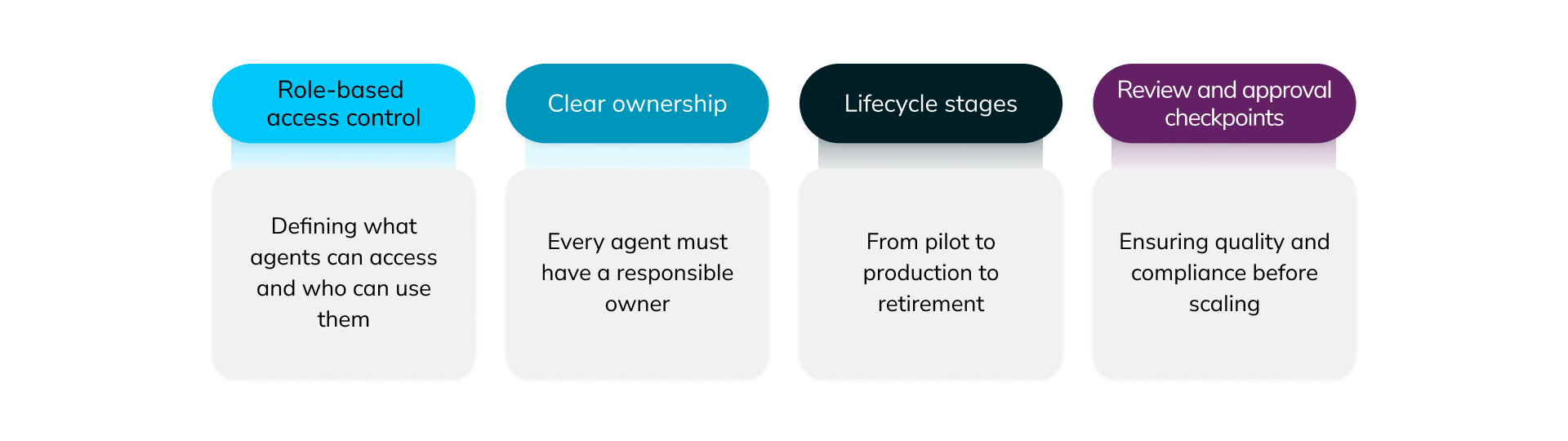
At its core, this means defining who owns an agent, what it can access, how it evolves over time, and where approvals are required before scaling.
Effective lifecycle management keeps the agent landscape efficient, relevant, and under control.
Want to go deeper? In our follow-up blog, How to Manage Your Agent Lifecycle, we explain how to classify agents by risk and complexity, define governance zones, and manage them through structured lifecycle stages.
4. Govern information and data access
The biggest risks around AI agents usually do not come from the agent itself, but from the data it can access, process, or expose.
Organizations need to define:
- Approved knowledge sources
- Data sensitivity classifications
- Access rules and boundaries
- Validation mechanisms for outputs
This becomes especially important when agents interact with internal documents, customer information, or business-critical systems.
Effective information governance ensures that data is used appropriately, compliance requirements are met, and outputs can be trusted.
As agents become more autonomous, governance shifts from infrastructure alone to data, access, and decision-making control.
5. Monitor, optimize, and continuously improve
AI agents are not set-and-forget solutions. Without continuous monitoring, organizations risk uncontrolled growth, rising costs, declining quality, and unnoticed security exposures.
To stay in control, usage, performance, cost, and access must be continuously reviewed, enabling organizations to identify what works, fix what doesn’t, and retire what no longer delivers value.
Tools like Agent 365, Microsoft 365 Admin Center, and Power Platform Admin Center provide visibility into adoption and consumption, while dashboards and audit logs support performance and security monitoring.
Ultimately, continuous monitoring ensures the agent landscape remains efficient, secure, and aligned with business value.
The real challenge is scaling with control
The five pillars in this framework are not separate measures. Together, they form a connected operating model for scaling agents responsibly.
Governance sets the boundaries, inventory creates visibility, lifecycle management ensures control, data governance reduces risk, and monitoring drives improvement. Together, these capabilities help organizations move from fragmented experimentation to structured scale.
That shift matters because the real risk is not building too many agents. It is scaling them without a model for ownership, access, and accountability.
Organizations that act early can avoid unnecessary complexity, close governance gaps, and focus on where agents create real business value.
/1.%20Visuals/Website/Icons/x-twitter.svg)


