


/1.%20Visuals/Website/Icons/RegulatoryCompliance_Visuals_Navigation%20(1).png?width=40&height=40&name=RegulatoryCompliance_Visuals_Navigation%20(1).png)


/1.%20Visuals/Website/Icons/Testing_Visuals_IconNavigation%20(1).png?width=40&height=40&name=Testing_Visuals_IconNavigation%20(1).png)


/1.%20Visuals/Website/Icons/government%201.png?width=40&height=40&name=government%201.png)
/1.%20Visuals/Website/Icons/energy_utilities%201.png?width=40&height=40&name=energy_utilities%201.png)
/1.%20Visuals/Website/Icons/defense%201.png?width=40&height=40&name=defense%201.png)
/1.%20Visuals/Website/Icons/food%201.png?width=40&height=40&name=food%201.png)
/1.%20Visuals/Website/Icons/finance%201.png?width=40&height=40&name=finance%201.png)
/1.%20Visuals/Website/Icons/manufacturing%201.png?width=40&height=40&name=manufacturing%201.png)


/1.%20Visuals/Website/Icons/CTG%20Academy.png?height=56&name=CTG%20Academy.png)


 Austria
 Belgium
 Denmark
 Germany
 Italy
Italy Romania
 Sweden
 Switzerland
 The Netherlands
 United Kingdom
 United States
At Cegeka, sustainability is a core business principle, not a side initiative. As a global IT services provider, we see technology as a driver of positive change, especially in our data centers, where performance, energy use, and environmental responsibility intersect.
By placing sustainability at the heart of operations, Cegeka is actively working towards its Environment, Social and Governance (ESG) ambition of becoming carbon neutral in Scope 1 and 2 by 2030, starting with cloud services in Belgium and the Netherlands. This demonstrates that business performance and sustainability can reinforce each other.
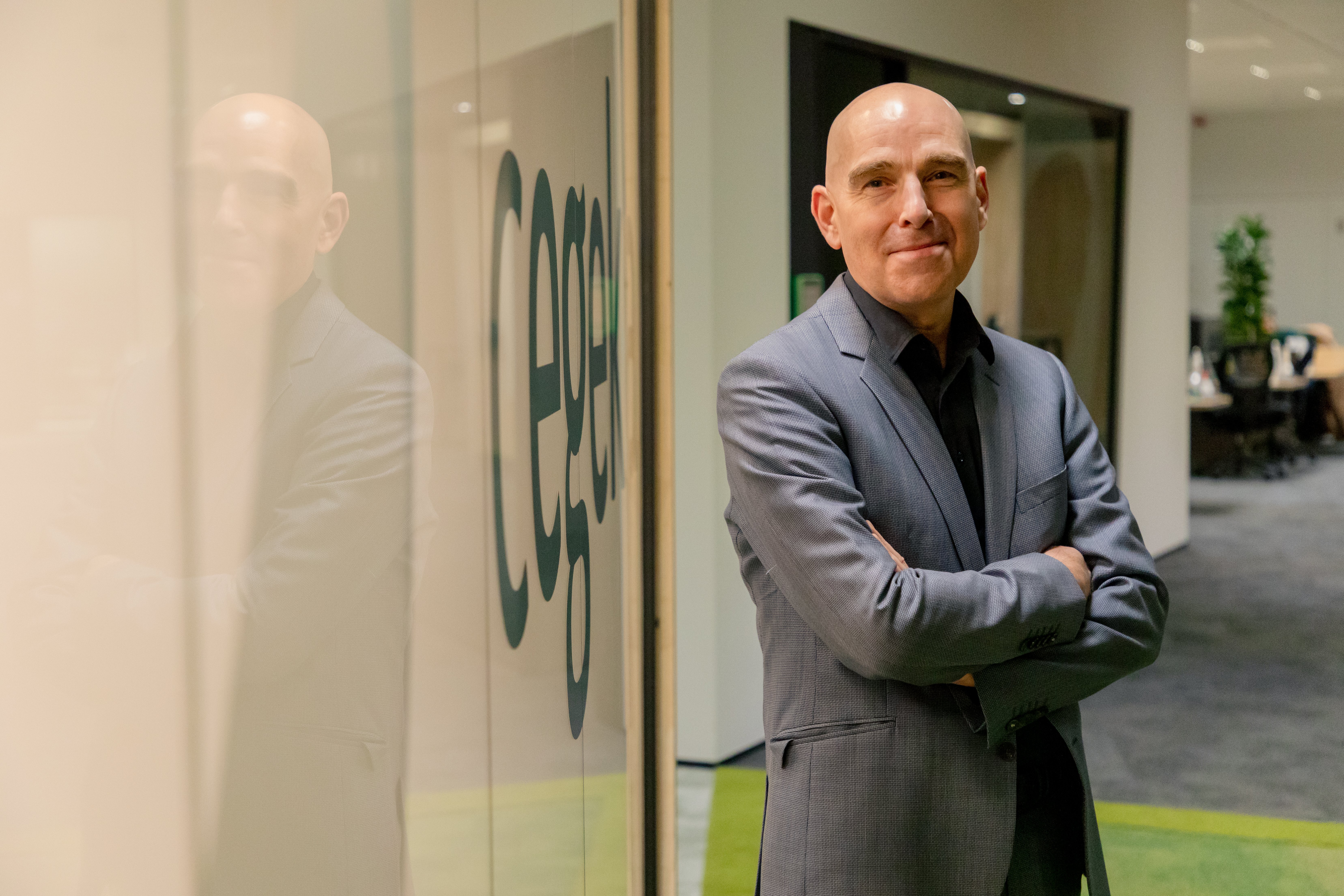
Recently, Luc Greefs, our Chief Technology Officer (CTO), joined Cegeka's long-term partner HPE Financial Services to share insights into our strategic collaboration on hardware circularity, which is an important component of our climate decarbonization journey.
A dual responsibility: performance and planet
For Luc, sustainability is both a personal and professional commitment. Responsible for Cegeka's data centers, he is aware that data centers are among the company’s largest contributors to carbon emissions. “I’m responsible for the ‘E’ in ESG,” Luc explains.
Sustainability is central to running Cegeka’s data centers, which represent our company’s largest source of carbon emissions: “Data centers carry a significant footprint, but they also give us the biggest opportunity to make a real difference”, says Luc.
Modernizing IT while minimizing waste
Historically, Cegeka explored multiple paths for retiring equipment: donations, recycling, returns to leasing partners, but the process lacked consistency and visibility. Different vendors meant different outcomes, and it was difficult to track where assets ultimately ended up.
Rather than viewing these refresh cycles as wasteful, we saw an opportunity: extending the value of IT assets beyond their first life, while reducing environmental impact and improving transparency.
In partnership with HPE Financial Services, we implemented a single global IT Asset Disposition (ITAD) process for all brands and all equipment. This ensures secure decommissioning, certified data erasure, and responsible reuse or recycling.
According to Luc, “We now have one way of working and full transparency into what leaves our company”.
Measurable impact
In 2025 alone, Cegeka returned 812 assets through ITAD, of which 72% were refurbished, and the rest responsibly recycled.
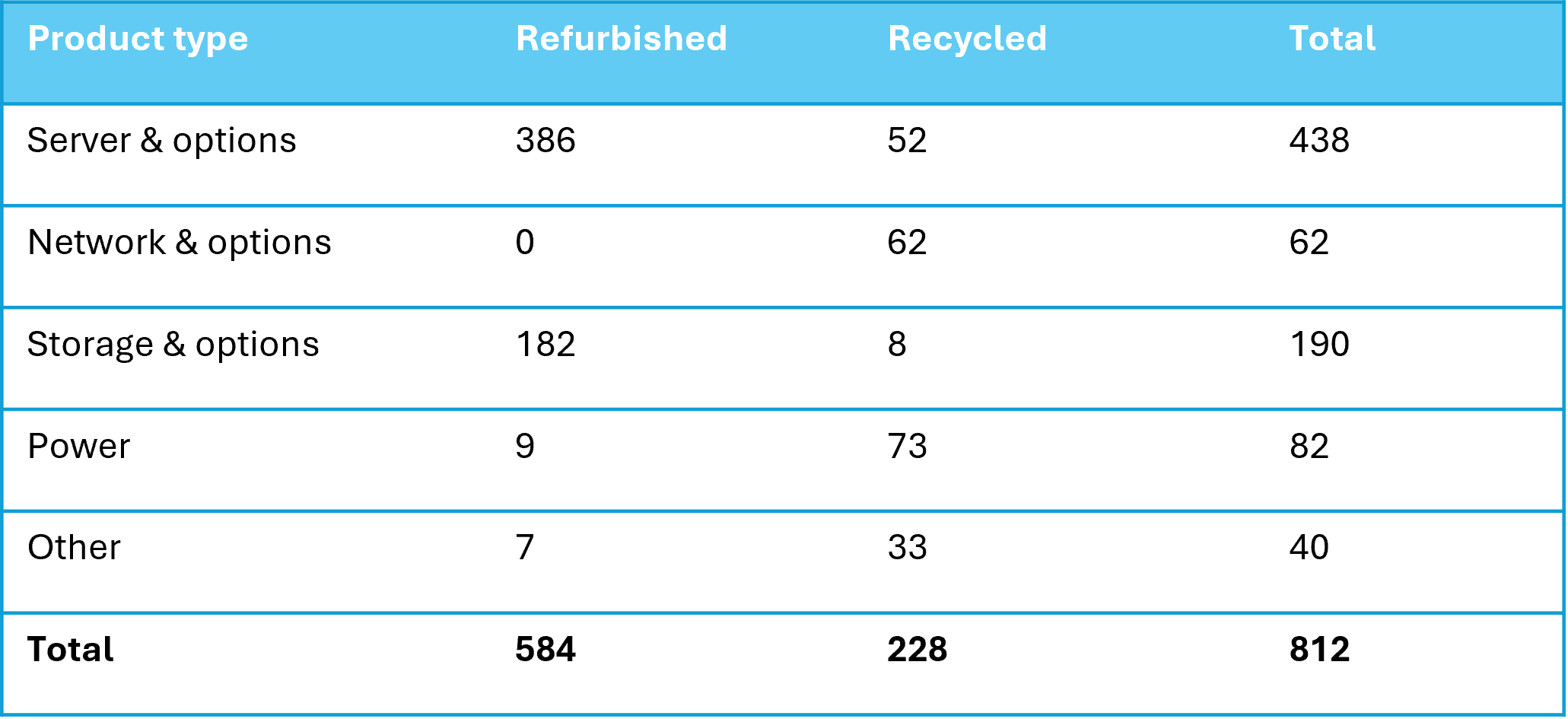
Detailed circular economy reports support accurate ESG reporting and carbon accounting. “Calculating carbon is not simple,” Luc says, “without reliable data and transparency, sustainability becomes guesswork.”
Circularity at Cegeka is not only about emissions, but also about reinvestment. Our intent is to loop back financial returns generated from ITAD into Cegeka’s sustainability roadmap. “Our goal is to create a closed system,” Luc explains. “The value we recover can be reinvested in energy projects, carbon compensation initiatives, or community-based programs like reforestation.”
Sustainability that strengthens the business
Linking circularity to our core operations helps us reduce our footprint while also offering more sustainable digital services to our customers. This way, ESG becomes a competitive advantage for Cegeka, as opposed to a cost.
Looking ahead: learning, adapting, leading
Cegeka continues to refine its carbon accounting, improve accuracy across all types of emissions, and learn through each investment cycle. From renewable energy production, such as wind and solar, to circular hardware strategies, progress is iterative by design.
"It’s a journey,” Luc reflects. "But sustainability has to be credible, transparent, and connected to how you actually run your business.”
For us, circular IT is no longer a program treated as a standalone initiative. It’s simply how we operate, proof that responsible technology management can drive both sustainable impact and long-term growth.
This story can also be visited here, on the HPE Financial Services’ website.
/1.%20Visuals/Website/Icons/x-twitter.svg)


