


/1.%20Visuals/Website/Icons/RegulatoryCompliance_Visuals_Navigation%20(1).png?width=40&height=40&name=RegulatoryCompliance_Visuals_Navigation%20(1).png)


/1.%20Visuals/Website/Icons/Testing_Visuals_IconNavigation%20(1).png?width=40&height=40&name=Testing_Visuals_IconNavigation%20(1).png)


/1.%20Visuals/Website/Icons/government%201.png?width=40&height=40&name=government%201.png)
/1.%20Visuals/Website/Icons/energy_utilities%201.png?width=40&height=40&name=energy_utilities%201.png)
/1.%20Visuals/Website/Icons/defense%201.png?width=40&height=40&name=defense%201.png)
/1.%20Visuals/Website/Icons/food%201.png?width=40&height=40&name=food%201.png)
/1.%20Visuals/Website/Icons/finance%201.png?width=40&height=40&name=finance%201.png)
/1.%20Visuals/Website/Icons/manufacturing%201.png?width=40&height=40&name=manufacturing%201.png)


/1.%20Visuals/Website/Icons/CTG%20Academy.png?height=56&name=CTG%20Academy.png)


 Global
 Austria
 Belgium
 Denmark
 Germany
 Italy
Italy Romania
 Sweden
 Switzerland
 The Netherlands
 United Kingdom
 United States
That rapid growth introduces a challenge many organizations underestimate. Building an AI agent is relatively easy. Managing dozens or even hundreds of agents as they become more widely adopted is where complexity starts to emerge.
The reality is simple: not all agents should be managed in the same way.
Yet many organizations fall into one of two extremes. They either apply the same governance model to every agent, creating unnecessary friction, or they apply little to no governance at all until risks begin to surface.
Neither approach scales.
To strike the right balance, organizations need a framework that connects how agents are used, the level of risk they introduce, and the amount of governance they require.

One governance model does not fit all
Consider two very different examples.
A marketing employee creates a personal agent to help draft social media content. Meanwhile, another team deploys an agent that accesses customer contracts, interacts with business systems, and supports critical operational activities.
Treating both agents the same makes little sense.
The first would likely be slowed down by excessive controls, while the second could expose the organization to significant risk if no governance is applied.
The challenge is that many organizations lack a consistent way to make this distinction. Governance decisions are often made ad hoc, based on individual projects or departments rather than a structured framework.
The result is predictable: some agents are overgoverned, others are undergoverned, and both scenarios limit the value organizations can realize from AI.
Risk and complexity are what really matter
A more effective approach is to assess agents based on two dimensions:
- Technical complexity
- Business and operational risk
- The sensitivity of the data being accessed
- The number of users affected by the agent
- The business criticality of the process it supports
- Regulatory and compliance requirements
Complexity relates to factors such as integrations, autonomy, and the overall architecture of the agent.
Risk is driven by a combination of factors, including:
When these two dimensions are combined, distinct governance needs begin to emerge.
Not every agent requires the same level of governance
The model below illustrates how agents can be grouped into different governance zones based on their level of risk and complexity.
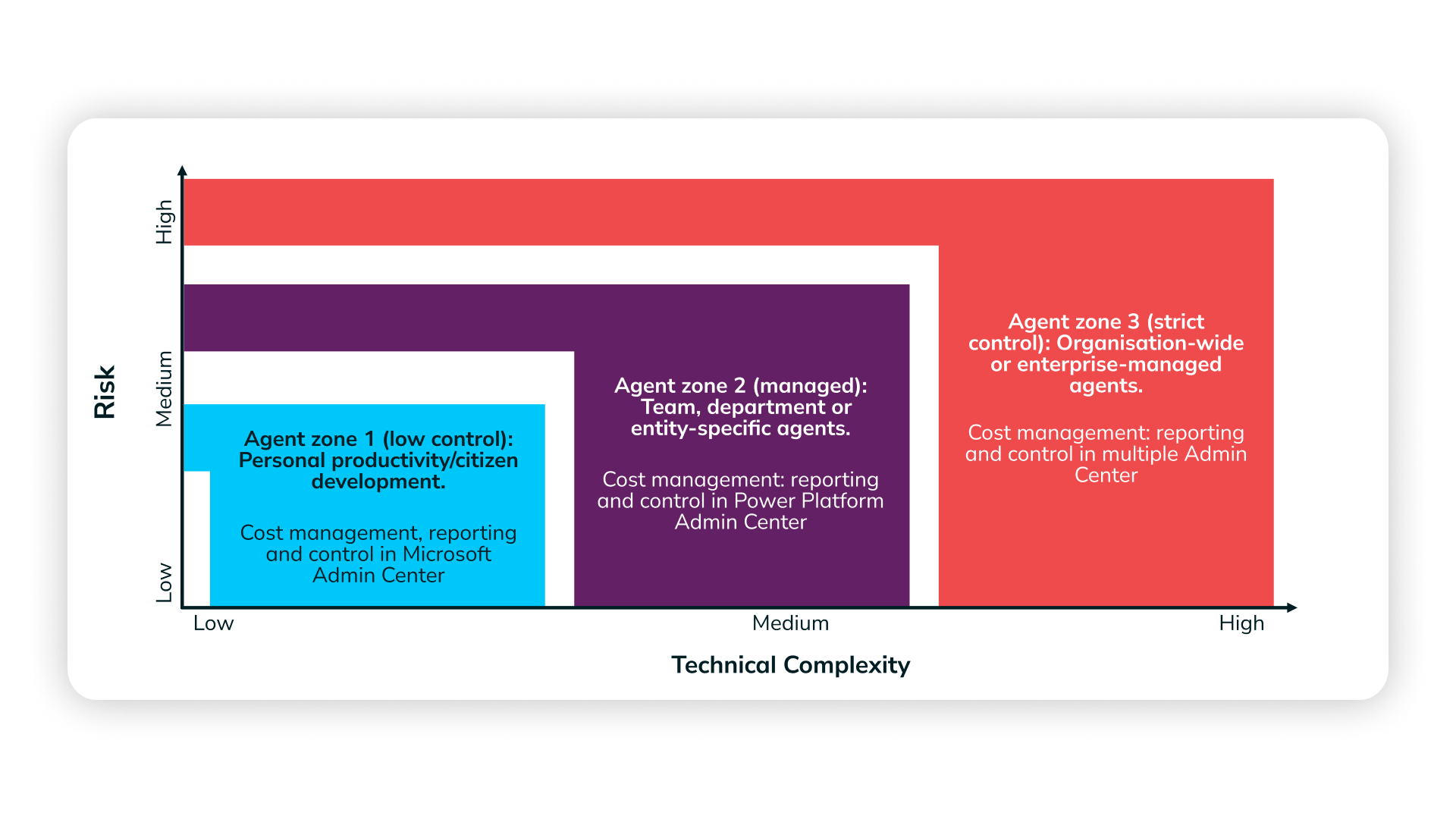
Figure 1: Agent zones explained
At the lower end of the spectrum are personal productivity agents with limited reach and impact. As agents become more widely used, interact with additional systems, or support business-critical activities, the level of governance naturally increases.
The goal is not to restrict innovation. The goal is to ensure that control grows in proportion to impact.
Agent type defines usage. Zone defines governance.
One of the biggest misconceptions organizations make is assuming that governance can be determined solely by who uses the agent.
A common assumption is:
- Personal agents are low risk
- Team agents are medium risk
- Enterprise-wide agents are high risk
In reality, the picture is far more nuanced.
An agent's type simply describes its audience—whether it is used by an individual, a team, or the entire organization. Governance requirements are determined by the agent's characteristics, not its audience alone.
For example, a personal agent connected to sensitive HR or financial data may require significantly more oversight than a departmental agent operating on non-sensitive information.
This distinction is important because it prevents organizations from applying unnecessary controls where they add little value, while ensuring that higher-risk agents receive the attention they require.
As a simple rule:
‘’Agent type defines usage. Zone defines governance.’’
Using classification to make consistent decisions
Once organizations understand that not all agents are equal, the next challenge becomes classification.
How do you determine which governance approach is appropriate for a specific agent?
A structured classification framework can help answer that question.
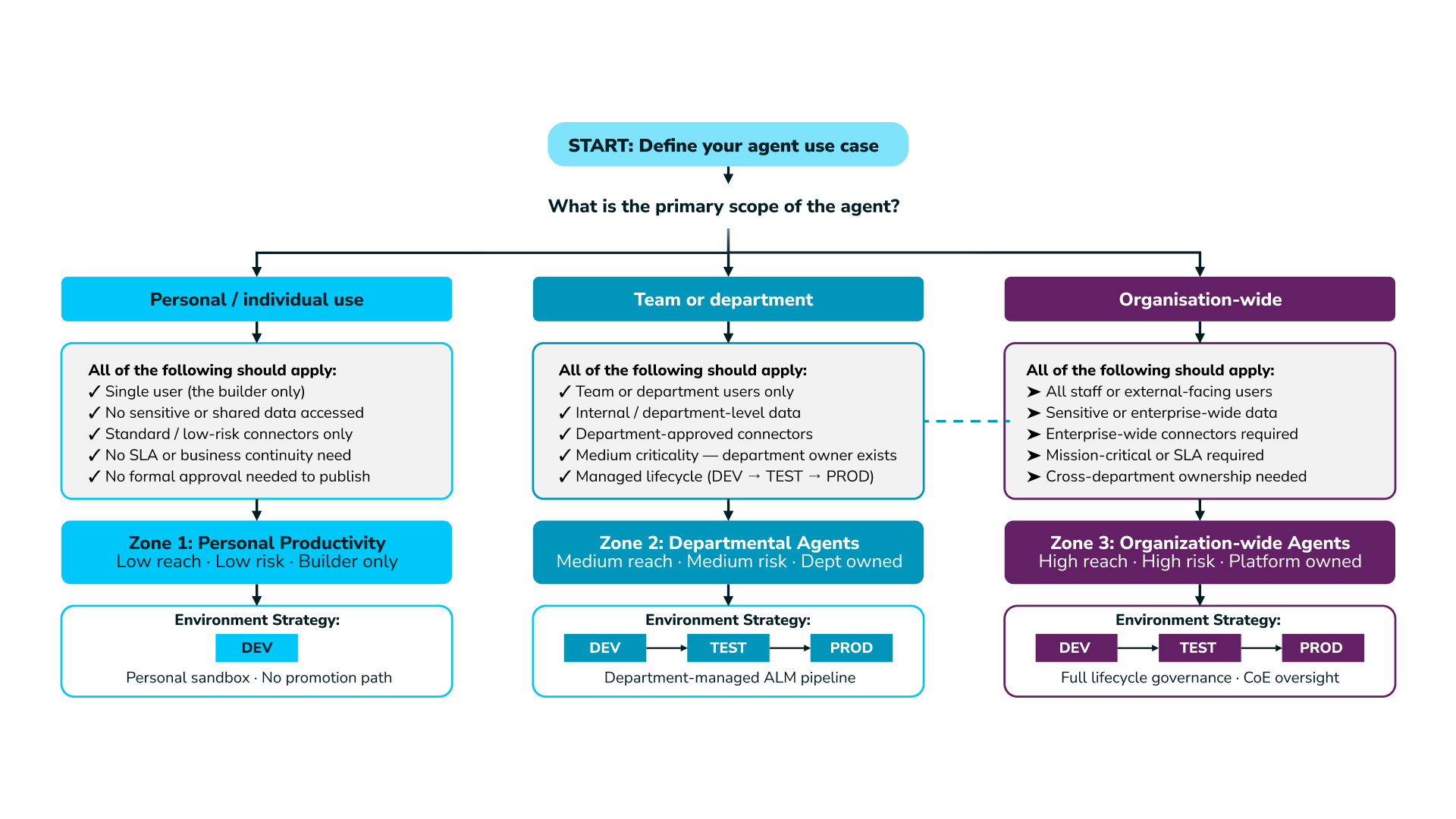
Figure 2: Agent Classification & Environment Strategy Decision Tree
The process starts by assessing a few fundamental questions:
- Who will use the agent?
- What data does it access?
- Which systems does it interact with?
- How dependent is the business on its output?
These questions provide a practical way to evaluate an agent's risk and complexity profile.
Rather than relying on assumptions or individual interpretations, organizations can make governance decisions using consistent criteria. This becomes increasingly important as the number of agents grows and different teams begin creating their own solutions.
Without such a framework, agents are often classified inconsistently, creating governance gaps and making oversight far more difficult over time.
Governance is not a one-time exercise
Another common mistake is treating governance as something that happens only at deployment.
In reality, the governance profile of an agent changes over time.
An agent that starts as a personal productivity tool may eventually be shared across a department. A departmental solution may evolve into an organization-wide capability. New integrations may be added, user adoption may grow, or additional data sources may be introduced.
As agents evolve, their governance requirements evolve as well.
That means organizations need more than an initial classification. They need a process that periodically reassesses whether an agent still belongs in the same governance zone.
Without regular evaluation, agents can gradually become more critical, more complex, and more risky without anyone adjusting the governance measures around them.
Successful organizations therefore view governance as an ongoing discipline rather than a one-time approval process.
Scaling agents with confidence
There is no universal governance framework that applies to every organization.
The right approach depends on factors such as regulatory requirements, risk appetite, organizational maturity, and the types of agents being deployed.
However, the underlying principles remain remarkably consistent.
Organizations that successfully scale AI agents:
- Classify agents based on risk and complexity rather than assumptions
- Apply governance proportional to business impact
- Reassess agents as their usage and scope evolve
- Balance innovation with control
Those that do this well avoid the two extremes that often undermine AI initiatives: excessive governance that slows innovation, or insufficient governance that creates unnecessary risk.
Ultimately, success with agentic AI is not defined by how many agents an organization builds.
It is defined by how effectively those agents are managed as they grow from individual experiments into business-critical capabilities.
Where to start
Navigating agent governance without a clear baseline is one of the most common mistakes organizations make. Before defining governance zones, environments, or lifecycle policies, you need to understand where you stand today.
Cegeka’s AI Agent Governance Assessment gives you exactly that: a focused review of your current governance setup, a clear view of the gaps and risks, and a practical roadmap for what to put in place before you scale further.
It’s the practical first step toward an agent landscape that scales with confidence, not complexity.

/1.%20Visuals/Website/Icons/x-twitter.svg)


