


/1.%20Visuals/Website/Icons/RegulatoryCompliance_Visuals_Navigation%20(1).png?width=40&height=40&name=RegulatoryCompliance_Visuals_Navigation%20(1).png)


/1.%20Visuals/Website/Icons/Testing_Visuals_IconNavigation%20(1).png?width=40&height=40&name=Testing_Visuals_IconNavigation%20(1).png)


/1.%20Visuals/Website/Icons/government%201.png?width=40&height=40&name=government%201.png)
/1.%20Visuals/Website/Icons/energy_utilities%201.png?width=40&height=40&name=energy_utilities%201.png)
/1.%20Visuals/Website/Icons/defense%201.png?width=40&height=40&name=defense%201.png)
/1.%20Visuals/Website/Icons/food%201.png?width=40&height=40&name=food%201.png)
/1.%20Visuals/Website/Icons/finance%201.png?width=40&height=40&name=finance%201.png)
/1.%20Visuals/Website/Icons/manufacturing%201.png?width=40&height=40&name=manufacturing%201.png)


/1.%20Visuals/Website/Icons/CTG%20Academy.png?height=56&name=CTG%20Academy.png)


 Austria
 Belgium
 Denmark
 Germany
 Italy
Italy Romania
 Sweden
 Switzerland
 The Netherlands
 United Kingdom
 United States
When doing vulnerability & compliance management, you should add two extra layer on top of tooling you use.
Layer 1 : Context based vulnerability & Compliance management
First of all it is key to reclassify vulnerability according to the context. A classical example is the critical vulnerability on a systems which is not connected to the Internet. This is also described in our previous blog. However you should and have to go one step further = Risk Register.
You need a CMDB. CMDB (Configuration Management Database) is a central database that stores details about all IT components (CIs) and their relationships. This is often considered the "heart" of IT Service Management (ITSM). Doing vulnerability management without a CMDB is guesswork/liking flying blind.
Layer 2 : Risk Register to Unite Vulnerability and Compliance Management
Many organizations operate vulnerability management, compliance management, and risk management as loosely connected—or entirely separate—functions. Vulnerability scanners generate findings, compliance teams track control adherence, and risk registers live in spreadsheets reviewed quarterly by governance committees.
When these disciplines are not integrated, organizations accumulate data but lack decision clarity. A well-maintained risk register can serve as the mechanism that correlates vulnerabilities and compliance gaps to business risk.
You must have a risk register, where all the risks that are accepted are inventoried. The main goal is work from your vulnerabilities and compliance gaps towards this overview of risks. This is an action which is sadly often not taken.
What a Risk Register Actually Represents?
A risk register is not merely a list of problems. When used correctly, it captures:
- Risk statements (cause, event, impact)
- Likelihood and impact assessments
- Risk owners accountable for decisions
- Treatment decisions (mitigate, accept, transfer, avoid)
This structure makes the risk register the natural home for translating both vulnerabilities and compliance failures into language the business understands.
Mapping Vulnerabilities & Compliance gaps to Risks
Not every vulnerability or compliance finding deserves individual representation in a risk register. The goal is not duplication, but aggregation and interpretation. For example:
"Unpatched externally facing authentication systems may allow unauthorized access, leading to data breach and service disruption."
Here, vulnerability management provides evidence; the risk register provides meaning. This approach prevents teams from managing risk one CVE at a time—a strategy that does not scale.
Translating Compliance Gaps Into Business Risk
Compliance management identifies where controls do not meet prescribed standards. On its own, this answers the question: Are we compliant?
The risk register answers the more important question: So what?
When compliance gaps are linked to the risk register:
- Some gaps become clearly low-risk and acceptable
- Others reveal systemic control failures requiring investment
- Risk acceptance becomes explicit and documented
What to do with a risk register?
Once you have this risk register. Your CISO Office(r) will perform together with the stakeholders one of the 3 following actions. These actions are on business impact:
-
Accept the risk
There are sometimes risks that need to be accepted due to the fact that these risks or better the related vulnerabilities or compliance issues cannot be solved. This is typically related to software which cannot be updated, but is key for production and where there is not short term solution. Sometimes these are also configuration settings which cannot be made compliant due to the fact that this will impact the applications which run on the system. Accepting risks is always with a due date (typically max 1 year), when you have to review the risks and assess whether you still will accept the risk or not. This also resolves a common tension: compliance deadlines versus operational reality. If a compliance-driven task is low risk, that decision can be explicitly accepted rather than silently ignored. -
Make it actionable
Create short term tasks of actions to mitigate or solve the risk by patching the vulnerabilities or correcting the configuration and making it compliant. -
Do nothing
Although not really an action, this is your to do list for the next patching cycle, but it is essential to have this list to have a complete view on your total risk. (see below)
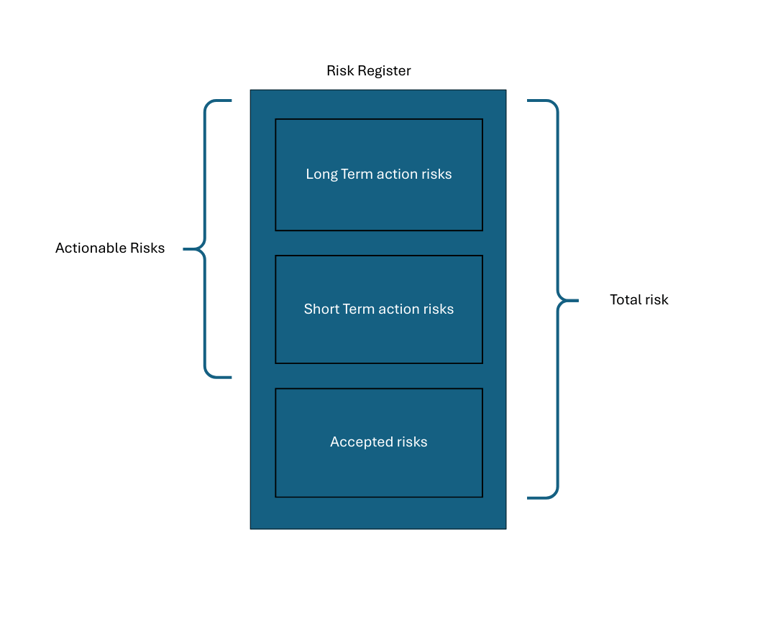
The results?
When vulnerability and compliance findings feed into a shared risk register, you will have engineering teams receive clearer justification for work, but also you executives see risk trends rather than raw findings. Often the number of (critical) vulnerabilities is used as a KPI for executive, now this is translated into business impact. Instead of arguing about severity scores, number of compliance gaps or audit findings, teams align around risk reduction objectives.
Conclusion
Vulnerability management finds weaknesses. Compliance management measures adherence. Neither, on their own, defines risk.
A risk register provides the connective tissue that transforms technical findings into business-relevant decisions. When vulnerability and compliance management feed into a shared risk register, organizations move from reactive remediation to intentional risk management.
The result is not fewer findings but clearer priorities, better accountability, and security efforts aligned with what actually matters to the business.
/1.%20Visuals/Website/Icons/x-twitter.svg)


