


/1.%20Visuals/Website/Icons/RegulatoryCompliance_Visuals_Navigation%20(1).png?width=40&height=40&name=RegulatoryCompliance_Visuals_Navigation%20(1).png)


/1.%20Visuals/Website/Icons/Testing_Visuals_IconNavigation%20(1).png?width=40&height=40&name=Testing_Visuals_IconNavigation%20(1).png)


/1.%20Visuals/Website/Icons/government%201.png?width=40&height=40&name=government%201.png)
/1.%20Visuals/Website/Icons/energy_utilities%201.png?width=40&height=40&name=energy_utilities%201.png)
/1.%20Visuals/Website/Icons/defense%201.png?width=40&height=40&name=defense%201.png)
/1.%20Visuals/Website/Icons/food%201.png?width=40&height=40&name=food%201.png)
/1.%20Visuals/Website/Icons/finance%201.png?width=40&height=40&name=finance%201.png)
/1.%20Visuals/Website/Icons/manufacturing%201.png?width=40&height=40&name=manufacturing%201.png)


/1.%20Visuals/Website/Icons/CTG%20Academy.png?height=56&name=CTG%20Academy.png)


 Global
 Austria
 Belgium
 Denmark
 Germany
 Italy
Italy Romania
 Sweden
 Switzerland
 The Netherlands
 United Kingdom
 United States
What comes to mind when you think about AI? There’s a good chance you immediately picture a chat window: an interface where you enter a question and get a response almost instantly.

That is no coincidence. We think in conversations, communicate through language, and ask questions to move forward. On top of that, many people were first introduced to AI through ChatGPT, which has strongly influenced how we perceive AI.
However, by mainly viewing AI as a chat interface, we overlook a large part of its potential. That is true both for those who work with it every day and for those who make strategic decisions.
AI is everywhere (without chat)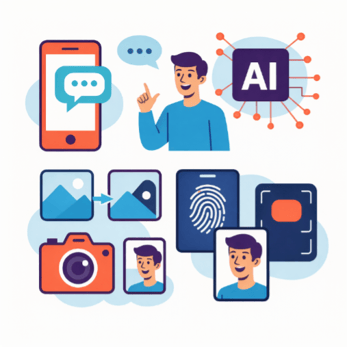
In everyday life, you constantly use technology in which AI is deeply embedded, often without noticing it.
When you take a photo with your smartphone and the lighting is not quite right, AI automatically adjusts the image. Unlock your phone with facial recognition or a fingerprint? Again, that is AI at work. No prompts, no chat, no conscious interaction.
Companies have also been using OCR (Optical Character Recognition) for years to read and interpret documents. With tools like Google Translate, you take a picture and immediately see a translation of the text. All these solutions rely on machine learning, yet they have rarely been described as ‘AI’.
Why we keep thinking of AI as a conversation
It is therefore understandable that many people reduce AI to a chat interface. Chat feels familiar and accessible: you do not need any training, you simply ask a question and receive an instant response.
Chat brought AI into view for a broad audience. For the first time, AI no longer felt like something in the background, but like something you could interact with directly. At the same time, this narrowed our perspective. As soon as the conversation turns to AI, most people immediately think of chat. That contrast matters. AI is not about conversation, but about functionality. It's about technology that operates independently, supports systems, and improves processes; most of the time completely in the background.
Why chat-based AI is hard to scale
When organizations rely on AI only through chat, they quickly encounter limitations. Chat is an excellent starting point, but it is very difficult to scale.
If every AI action must be triggered explicitly by a person, AI becomes dependent on human attention, and that creates a bottleneck. At the same time, companies design their processes to scale efficiently, standardize work, and remain predictable. It feels contradictory to suddenly revert to ad‑hoc conversations.
If you want to embed AI in a structural way, it is better not to start from conversations, but from processes. Let AI act on workflows, incoming emails, files that appear in predefined locations, or status changes in cases.
In that way, AI evolves from a “loud colleague” constantly asking for input into a quiet, reliable force working in the background.
From chat to autonomous agents: AI embedded in your processes
Chat can remain a useful entry point to AI, but it is only one UI layer. The real value lies underneath.
With autonomous agents, you activate AI proactively. They monitor processes, communicate with other systems or agents, and work independently towards an outcome. Without constant human intervention, unless you define it that way.
Where chat mainly supports one‑to‑one interaction, agents enable scalable collaboration. You do not create a single personal assistant, but a network of digital colleagues, each with a clearly defined role within a standardized setup.
This does not require completely new technology, but a different way of thinking.
Example: the lead-to-opportunity process with AI agents
Consider the journey from lead to opportunity. This CRM process has been around for years and helps teams collaborate efficiently.
In the first step, you use AI via chat to answer questions such as “Which leads came in today?” or “Create a summary of meeting X.” That immediately saves time.
True innovation, however, begins when you redesign the process itself and put AI at the center. Why continue qualifying leads manually if agents can independently collect online signals and make an initial assessment?
After conversations with leads, employees no longer need to write down action items or evaluate matches. Agents can perform these steps autonomously, taking into account strategy, context, and customer sentiment.
At that point, you are not just improving an existing workflow; you are building a smarter process.
More room for human work (when AI runs in the background)
 When AI supports your processes instead of imitating conversations, it creates space.
Time and attention shift to activities where people truly add value: building relationships, making decisions, thinking creatively.
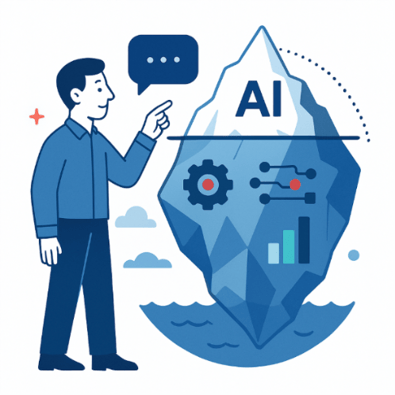
Chat still has its role. It is useful, visible, and familiar. But it is only the tip of the iceberg. Around 90% of AI’s impact remains out of sight. AI operates quietly, autonomously, and in the background. And that is where its greatest value lies today.
Do not start with conversations, start with processes
AI is not a chat product. It is a technology that makes systems smarter and fundamentally reshapes processes.
If you continue to approach AI mainly as something you talk to, you will quickly run into limitations.
When you start from processes and autonomy instead, you unlock scale, consistency, and sustainable impact.
The conclusion is clear: do not begin with conversations, begin with processes. Chat feels familiar, but AI goes far beyond that.
Curious what it looks like when AI is truly embedded in your processes?
Discover how AI agents at VTS quietly process thousands of files in the background and free up auditors to focus on work with real impact.

Ready to take that step? Contact us
/1.%20Visuals/Website/Icons/x-twitter.svg)


